> For the complete documentation index, see [llms.txt](https://netsec.nerd-cafe.ir/llms.txt). Markdown versions of documentation pages are available by appending `.md` to page URLs; this page is available as [Markdown](https://netsec.nerd-cafe.ir/network-engineering/ccna/setting-up-a-dhcp-server-on-a-cisco-router.md).
# Setting up a DHCP Server on a Cisco Router
Nerd Cafe
### **Scenario:**
You are configuring a **Cisco router as a DHCP server** to dynamically assign IP addresses to client devices on a local network.
### **1. Understanding DHCP**
DHCP (Dynamic Host Configuration Protocol) automatically assigns **IP addresses**, **subnet masks**, **default gateways**, and other parameters to network devices. A Cisco router can function as a DHCP server, providing these settings to clients.
### **2. Practical Scenario**
* You are setting up a small office network.
* The router will act as a DHCP server.
* The local network uses the **192.168.1.0/24** subnet.
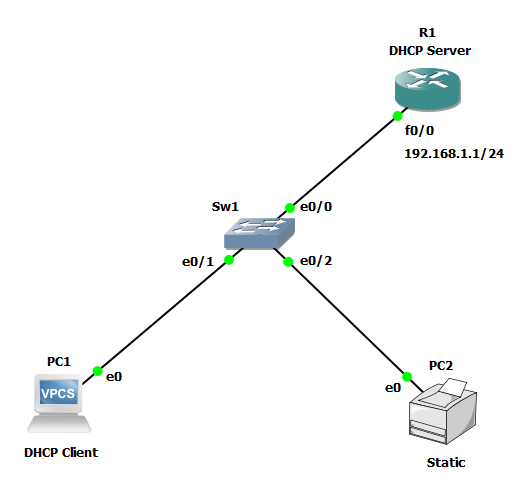
* The router's interface (**FastEthernet0/0**) will be the gateway **192.168.1.1**.
* The DHCP server should assign addresses from **192.168.1.100 to 192.168.1.200**.
* Some devices (like a printer) will need **static IP reservations**.
### 3. Network Topology
Topology
### **4. Configuration Steps**
#### **Step 1: Enter Global Configuration Mode**
Connect to the router via **CLI** (Console, SSH, or Telnet), then enter global configuration mode:
```
R1#configure terminal
Enter configuration commands, one per line. End with CNTL/Z.
R1(config)#
```
#### **Step 2: Exclude Reserved IP Addresses**
Reserve specific IP addresses that **should not be assigned** by DHCP (e.g., for the router, printers, and servers):
```
R1(config)#ip dhcp excluded-address 192.168.1.1 192.168.1.10
```
* **192.168.1.1** is the router’s IP.
* **192.168.1.2 – 192.168.1.10** are reserved for static devices.
#### **Step 3: Create a DHCP Pool**
Define a DHCP pool named **OFFICE\_NETWORK**:
```
R1(config)#ip dhcp pool OFFICE_NETWORK
R1(dhcp-config)#
```
#### **Step 4: Define the Network and Subnet Mask**
Specify the subnet for DHCP clients:
```
R1(dhcp-config)#network 192.168.1.0 255.255.255.0
```
#### **Step 5: Set Default Gateway**
Assign the router’s IP as the default gateway:
```
R1(dhcp-config)#default-router 192.168.1.1
```
#### **Step 6: Define the DNS Server**
Specify a DNS server (e.g., Google’s **8.8.8.8**):
```
R1(dhcp-config)#dns-server 8.8.8.8
```
#### **Step 7: Configure the Lease Time**
Set a lease duration (e.g., **24 hours**):
```
R1(dhcp-config)#lease 1 0 0
```
`1 0 0` means **1 day, 0 hours, 0 minutes**.
#### Step 8: Exit the DHCP Configuration
```
R1(dhcp-config)#exit
R1(config)#
```
#### Step9: Assign IP address to **fastEthernet 0/0** (Connected to PC1)
```
R1(config)#interface fastEthernet 0/0
R1(config-if)#ip address 192.168.1.1 255.255.255.0
R1(config-if)#no shutdown
```
#### Step 9: PC1 Configuration
```
PC1> ip dhcp
DORA IP 192.168.1.11/24 GW 192.168.1.1
PC1> show ip
NAME : PC1[1]
IP/MASK : 192.168.1.11/24
GATEWAY : 192.168.1.1
DNS : 8.8.8.8
DHCP SERVER : 192.168.1.1
DHCP LEASE : 86395, 86400/43200/75600
MAC : 00:50:79:66:68:00
LPORT : 20008
RHOST:PORT : 127.0.0.1:20009
MTU : 1500
PC1>
```
#### Step 10: Printer (Static IP)
* Manually set **IP: 192.168.1.2**, **Gateway: 192.168.1.1**.
* Ensure it doesn’t request DHCP.
```
PC2> ip 192.168.1.2/24 192.168.1.1
Checking for duplicate address...
PC2 : 192.168.1.2 255.255.255.0 gateway 192.168.1.1
PC2> show ip
NAME : PC2[1]
IP/MASK : 192.168.1.2/24
GATEWAY : 192.168.1.1
DNS :
MAC : 00:50:79:66:68:01
LPORT : 20010
RHOST:PORT : 127.0.0.1:20011
MTU : 1500
PC2>
```
### **5. Verifying DHCP Configuration**
#### **1. Check the DHCP Configuration**
```
R1#show ip dhcp pool
Pool OFFICE_NETWORK :
Utilization mark (high/low) : 100 / 0
Subnet size (first/next) : 0 / 0
Total addresses : 254
Leased addresses : 0
Pending event : none
1 subnet is currently in the pool :
Current index IP address range Leased addresses
192.168.1.1 192.168.1.1 - 192.168.1.254 0
R1#
```
This shows the active DHCP pool and available IP addresses.
#### 2. View DHCP Bindings (Leased IPs)
```
R1#show ip dhcp binding
Bindings from all pools not associated with VRF:
IP address Client-ID/ Lease expiration Type
Hardware address/
User name
192.168.1.11 0100.5079.6668.00 Mar 23 2025 05:54 AM Automatic
R1#
```
This displays assigned IP addresses and MAC addresses.
### **7. Troubleshooting Commands**
* Check if the DHCP service is running:
```
R1#show running-config | inclu
R1#show running-config | include dhcp
ip dhcp excluded-address 192.168.1.1 192.168.1.10
ip dhcp pool OFFICE_NETWORK
R1#
```
* Debug DHCP process:
```
R1#debug ip dhcp server events
DHCP server event debugging is on
```
### Keywords
`DHCP`, `Cisco Router`, `IP Address`, `Subnet Mask`, `Default Gateway`, `DNS Server`, `Lease Time`, `Excluded Address`, `DHCP Pool`, `Network Configuration`, `IP Binding`, `DHCP Reservation`, `Dynamic IP`, `Static IP`, `Show Commands`, `Debugging`, `Packet Tracer`, `Network Automation`, `Router Configuration`, `CCNA`, `سیسکو`